
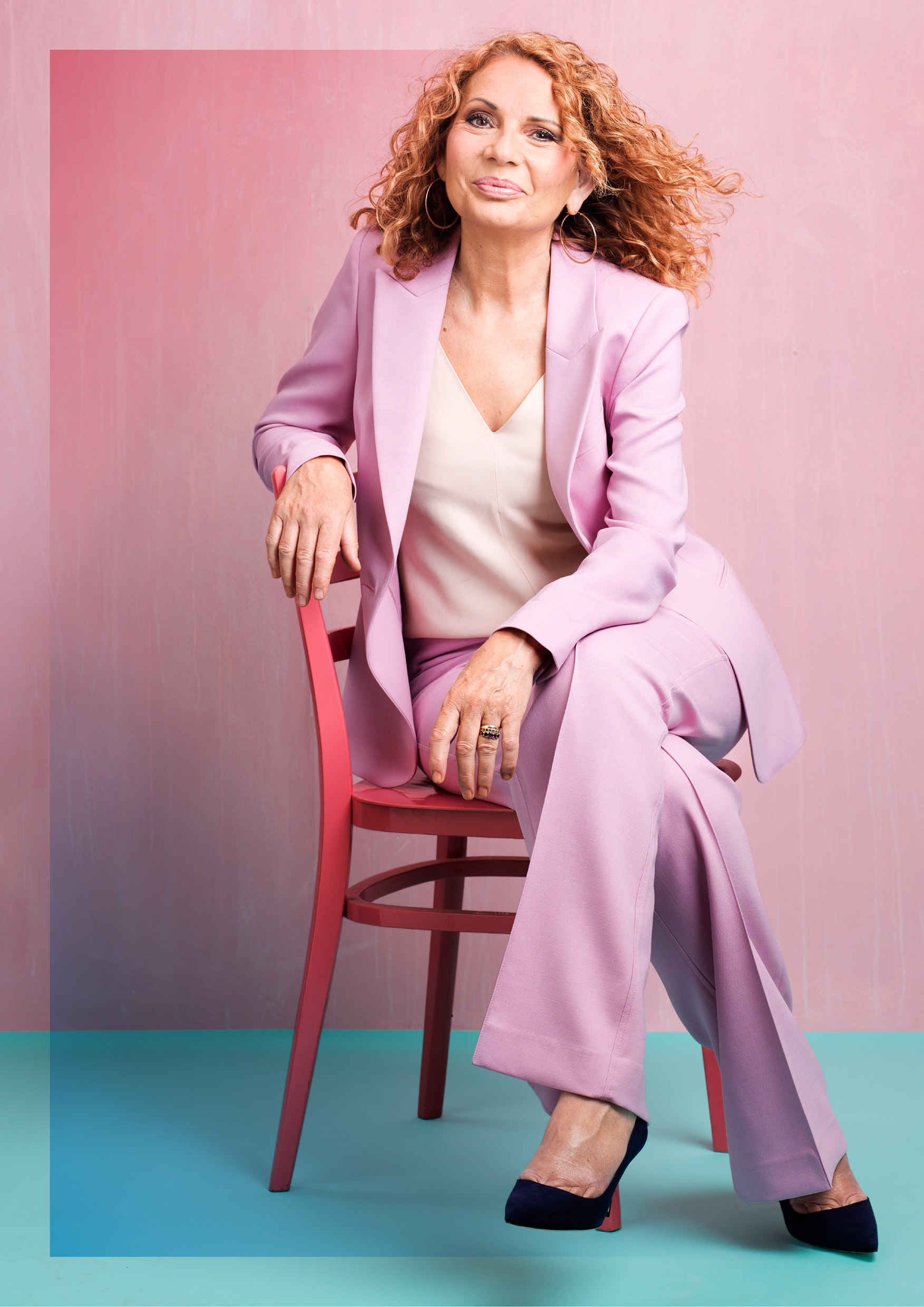
Joanna MacGregor CBE, 66, is a concert pianist, conductor and innovator. Susan Elkin spoke to her.
As the Zoom connection flashes on I see Joanna’s very familiar face in a light, bright room surrounded by pianos. “I’m in my teaching room at Royal Academy of Music”, Professor Joanna MacGregor tells me cheerfully. “This is a very busy time of year for us because we audition around 600 pianists in November and December, some face-to-face and some online. They come to the Royal Academy, where I’m Head of Piano, from all over the world. Sadly few of the applicants are British and, of those, even fewer will be good enough for an Academy place. That, sadly, is a reflection on the current state of music education in this country.”
Joanna is a musical polymath. As an A-list concert pianist she has played in eighty countries with most of the world’s topflight orchestras and conductors including Pierre Boulez and Sir Simon Rattle. She has premiered piano works by composers such as John Adams and James MacMillan and can often be seen and heard at venues such as Wigmore Hall, South Bank Centre and Barbican in London, as well as prestigious concert halls abroad. Then there are more than forty solo recordings ranging from JS Bach to Scarlatti.
For most virtuoso musicians, a performing career would be more or less enough, but there’s nothing conventional about Joanna. She chuckles modestly when I say this. “Well, like most musicians I think, eat and breath music” she says. That hardly explains how she found the energy to run the Dartington International Summer School from 2014-19 and the Bath International Music Festival from 2006-12 and many other festivals and events too numerous to list here. The details are all on her website www.joannamacgregor.net
Today, among her many other pursuits, Joanna is artistic director and principal conductor at Brighton Philharmonic Orchestra, which has a pretty illustrious 100-year history. “Many famous people have come down to play with BPO in the past including Rachmaninov and Rubenstein”, says Joanna, who has written a book commemorating the 2025 BPO Centenary, because writing is another of her accomplishments along with speaking. She has a series of music books PianoWorld to her name, writes programme notes and appears regularly on Radio 3 and TV. “I did the Building a Library with Andrew McGregor on his Record Review programme only last week”, she says, adding that the work in question was Bartok’s “marvellous” Second Piano concerto. The weekly slot gives an expert the opportunity to review different recordings of a piece before narrowing it down to a single recommendation. “Bartok was so good at incorporating folk music that he invented strange new time signatures in order to notate it”, she says happily.
“Part of the problem is that classical music is disappearing from public consciousness“
So what about the parlous state of British music education? “Part of the problem is that classical music is disappearing from public consciousness”, says Joanna. “When I was growing up you could simply turn on BBC 2 and there would be Andre Previn with the London Symphony Orchestra or Julian Bream with his guitar. All of that has gone now partly because we now live in a multi-channel world. The public is far less familiar with, or accepting, of classical music than it was even only 30 years ago.”
It makes programming concerts difficult too. “We find that audiences are much more willing to listen to something by a 20th or 21st century composer than an earlier one” says Joanna. “Getting people to focus on, say a symphony by Mozart or Haydn has become quite a challenge.”
She continues “And when it comes to player education in places like Scandinavia or Russian there are well established free pathways to enable talented young musicians to train. There’s a support system as there is for Olympic athletes – because the required stamina is very similar. Most of that has gone now in Britain, although schools like Purcell in Hertfordshire (I teach at the annual summer school there) and Chetham’s in Manchester are doing a good job and we have some wonderful youth orchestras. The situation is a little brighter for ensemble musicians than for pianists. Brass playing, for example, is still strong in the north of England and we see that filtering through to conservatoires such the Royal Academy.”
And that, of course, is a good source of contacts for Joanna. “I’ve booked Aaron Azunda Akugbo to play the Wynton Marsalis trumpet concerto at Brighton this month. I first knew him when he was a student here at the Academy,” she says.
“I just love sitting at the piano with a score and exploring it“
Joanna grew up in Brent where she was home-schooled until the age of 11 and taught piano by her mother before attending South Hampstead High School. She has fond memories of school. “My favourite activity, and always has been, is practising. I just love sitting at the piano with a score and exploring it. They used to let me work by myself at the baby grand in a small teaching room after school – sometimes until quite late in the evening”, she recalls, adding that of course such a thing would now be precluded by health and safety rules. “I practise every day and often spend several hours here at the Academy working at the piano after 6pm.”
Today, Joanna and her theatre director husband Richard Williams of nearly 40 years, live in rural East Sussex although she stays “in town” when she needs to be at Royal Academy of Music. “We lived in Brighton – Kemptown – for 20 years”, she says, when I quiz her about her evident affection for Brighton Philharmonic Orchestra, which is where I see her in action most often. “And we were in Liverpool – which I loved – for some years when Richard was running Liverpool Playhouse.”
In 2019 Joanna was a Booker Prize judge – this despite her claim to think of nothing but music. I ask her how on earth she fitted in reading a hundred books in a few months. “Oh yes, that was fun,” she says airily. “Actually, I think it was more than a hundred – sometimes I read two a day. And by the time it gets to the final decision you’ve read some of them three or four times as the list narrows down.” Joanna is certainly a woman of extraordinary time management skills.
She’s no bluestocking either. She sports a glamorous image on stage with her trademark dark curls and, often, astonishing high heels. And she has played a lot of jazz as well as classical music.
So what changes would Joanna like to see in order to re-focus public awareness of classical music? “Oh that’s easy” she says. “More on mainstream TV channels, please. Make the programmes simpler and drop the assumption that it’s all so boring that it has to spiced up. No one needs to be scared. There used to be an enormous appetite for classical music because everyone ‘owned’ it. Think of Myra Hess playing at the National Gallery during the war. In the 1940s Brighton Philharmonic routinely attracted audiences of three to four thousand.”
She continues: “And sometimes old-fashioned things are the best. I love doing illustrated talks about music. Tell them about the work and the life and times of the composer as colourfully as possible – and it works for all ages. I’ve done a lot of this and audiences really like it.”
As we switch off our zoom connection Joanna waves to me jovially. She is, given her eminence, astonishingly and warmly down to earth: every inch a communicator and a “people person”. I have seen her casually putting out music stands for soloists at Brighton or presenting post-performance bouquets when she’s not playing herself. Very few people with her CV would do this.