
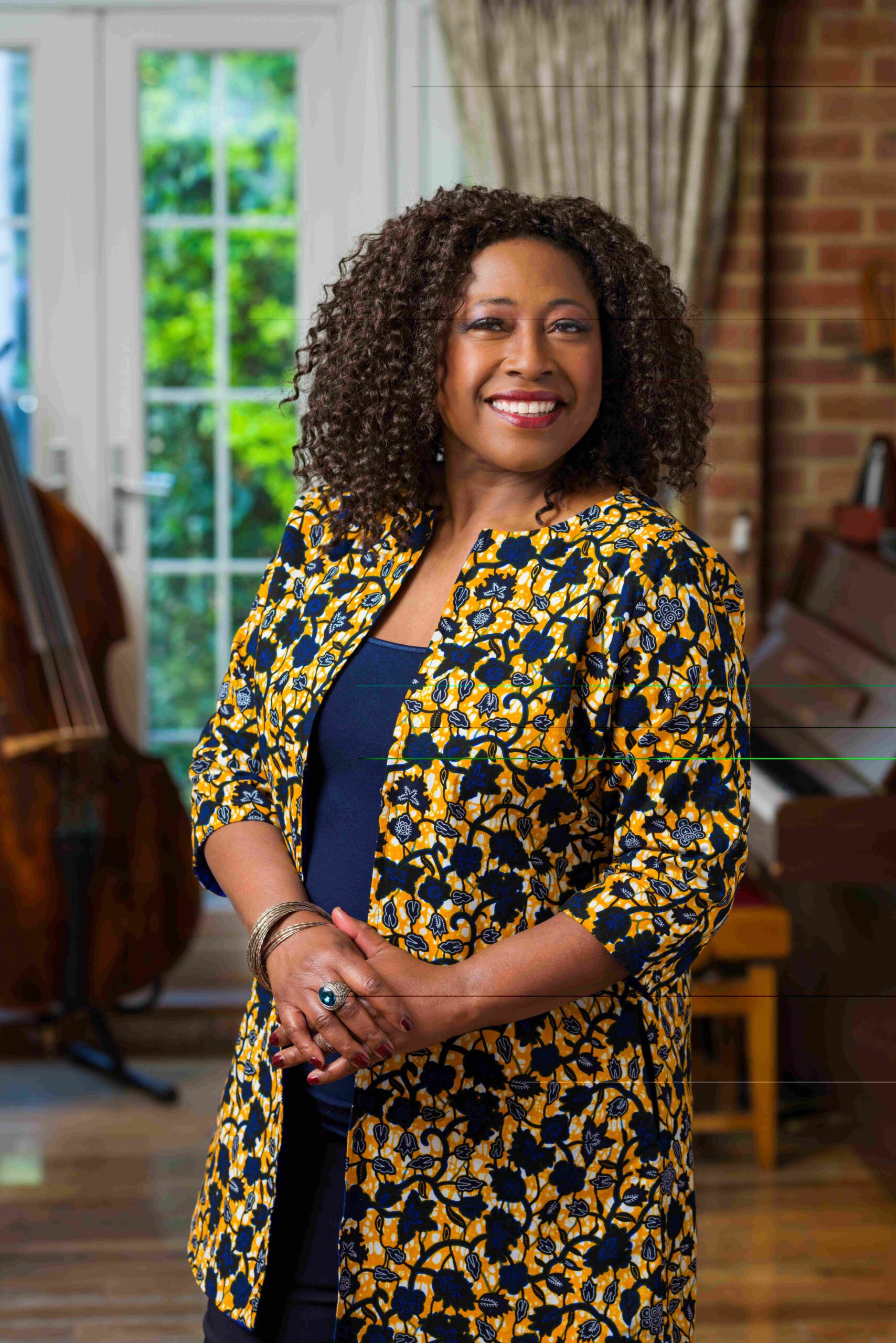
International soprano and Artistic Director of Pegasus Opera Company, Alison Buchanan, speaks to Nilgün Yusuf.
Fans of Bridgerton may have seen Alison Buchanan sing in the spinoff series, Queen Charlotte: A Bridgerton Story (2023) easily located on YouTube if you missed it. “That was a high point” the singer reflects. “I loved the show and the whole process. They treated me like artist.” Bejewelled and dazzling, Buchananperforms herself, an operatic soprano who moves her audience to tears with Dido’s Lament by Henry Purcell, When I Am Laid to Earth. The winner of Luciano Pavarotti’s 1996 International Voice competition, she has travelled the world and crossed paths with many greats including Plácido Domingo, Dame Joan Sutherland and Franc Zeffirelli, but Bridgerton remains a standout moment.
What most Bridgerton viewers are probably unaware of is that Buchanan is the Artistic Director of the Pegasus Opera Company – “the only black, British female Artistic Director of an opera company in the UK”, she adds, not insignificantly. She took the reins nine years ago when founder Lloyd Newton sadly died and left Pegasus to Alison in his will. “I’ll kill him when I see him.” she jokes affectionately. She first met Lloyd at the highly acclaimed 1986 Trevor Nunn production of Porgy and Bess at Glyndebourne. “We were cast as brother and sister. He became a brother in life too,” she reflects. Then, there were very few outlets for black opera singers, so six years later, Lloyd formed Pegasus to create more opportunities, and Buchanan was involved from the outset: teaching, performing, as Board member and Assistant Director.
“It’s great to see young people grow and conquer their performance anxieties and singing has many health benefits. I describe it as an inner massage.“
Officially celebrating their thirtieth anniversary this year – although it’s really thirty-four –Pegasus aims to demystify and make opera accessible to working-class and global majority children and young people by offering a broad programme of activity using music and creative participation to develop their confidence, creativity and musical skills. “People find it strange but I’m quite an introvert. In my own time, I like to mind my own business, but on stage I’m larger than life. I’m blessed to be given this life and platform. It’s great to see young people grow and conquer their performance anxieties and singing has many health benefits. I describe it as an inner massage. It elevates your mood, lowers blood pressure, energises and soothes, makes you happier and calmer. It’s a way to express yourself, connect with your artistic soul and to be heard.”
Through their Learning and Participation strand led by Harriet Kelly, with the motto, Harmony in Diversity, Pegasus brings opera to schools and communities around the country. “Your colour can exclude you from this kind of work. Some believe they aren’t wanted or don’t belong. Many kids in the schools we go to don’t expect people who look like us to make the noise we make. We break the stereotypes.” Central to the Pegasus ethos is that global majority young people should encounter a more diverse range of artists, stories and experiences. “I know how important it is for kids to see someone who looks like them doing what we do. Like when Obama became president, young people across the world thought, ‘yes, it’s possible.’”
Speaking to the singer from her US home, Buchanan divides her time between London and New York, Buchanan is a passionate advocate for greater global majority representation and opportunities. She deplores all forms of misogyny and racism and salutes those who’ve inspired or informed her journey, attitude and work: “Leontyne House, Jessye Norman, Maya Angelou, Miriam Makeba, Langston Hughes, Richard Wright, Muhammed Ali, Cicely Tyson – they’re all my heroes. They all decided they wouldn’t toe the line and wouldn’t allow society to instruct them.”
So, why isn’t opera more diverse? “There are so many barriers. It’s foreign so no one understands it, it’s expensive to follow, you have to dress up to do it and the perception is an artform for the rich and white – and that’s a perception many in opera would prefer to keep.” For the 2025/26 academic year, the Learning and Participation strand of Pegasus reached approximately 7,100 participants and audience members across 70 different events and around 200 sessions, workshops and performances, directly engaging approximately 4,000 children and young people.
“We make opera accessible through telling stories. How you frame the story is how to get their interest.“
“When we go into schools, the older students will often look disinterested at first and slump in their chairs. Then you see them gradually straighten up, start to take notice and listen. The younger ones really visibly react when we sing high and loud. It’s such fun to see the reactions. We make opera accessible through telling stories. How you frame the story is how to get their interest. You know, ‘This story is about a princess’ – we convey the excitement, make an impact and touch lives.”
So how did a state-educated Bedfordshire girl come to be an internationally renowned virtuoso soprano? Her dad, Keith Harding was from Barbados and fixed televisions for Granada TV Rental. Her mum, Lena Harding from Jamaica was a council administrator. “There was always music at home. We had an old record player and the collection was typically West Indian: reggae, Soca, the Jim Reeves Christmas Album, the waltzes of Strauss, Motown, R&B.” Buchanan initially attended a black church and hoped to sing in the choir. But the pastor wasn’t happy when she asked why there were no dinosaurs in the Bible. So, at 13 she joined the All Saints Church Choir led by David Bach and part of a High Anglican Catholic Church, where she was welcomed and her dinosaur questions answered.
She started at Bedford High School where the music master was Philip Bond. “Bedford Music Hub offered lots of opportunities to sing – it was tremendous.” She then moved to Junior Guildhall for four years where she also did a Diploma in singing and performing. This was all paid for through Bedfordshire County Music Services and the local authority of Bedford who also paid for travel back and forth between Bedford and London. “It takes a village to raise a singer” she adds, as she considers the many people who have helped develop her talent along the way. She completed her Masters at the Curtis Institute where she worked with Slyvia Ogden Lee, a black woman who could have passed as white. “No nonsense, she said it like it was, proudly described herself as the daughter of slaves and was a fantastic advocate for black music and singers.” Her education was capped as a young artist at San Francisco Opera and she was on her way.
Buchanan first heard opera while rifling through her father’s record collection at the age of 10. “It was a white woman, Christa Ludwig, singing Brahms: Alto Rhapsody.” She had never heard such a sound before and at school set about imitating her. “To be honest, I mimicked her to disrupt the class – I was very good at imitating. My form teacher, Lloyd Barnett, gave me various instruments to play but when he heard me sing, he said: “You have a good voice. Would you like voice lessons?” “Will I get out of Maths?” she asked. “No,” he answered. Her first voice lessons were at age 11 with Anne Rose, provided by Bedfordshire music services when she was at Westfield Middle School. Additionally, her dad drove her an hour and a half through rush hour every week to Watford School of Arts for a half hour lesson with David Joiner who told her about the Porgy & Bess audition at Glyndebourne where she got a mention on the front page of the Guardian with the headline: High School Girl Hits the High Notes.
Alison Buchanan’s talent was spotted early on and she’s passionate about nurturing the next generation: “I want a level playing field and expect the highest level. We do workshops with teachers to show they don’t need to know about opera to teach it. It’s for those who wish to change and diversify the curriculum. During the Covid Lockdown, Nicholas Boyd, then Chair of Pegasus, suggested we do a call out to opera companies asking: “Do you stand with us against injustice?” Glyndebourne were the first to come forward and the only one to back up this pledge with financial support. “This led to our Glyndebourne collaboration and mentoring scheme to encourage and nurture talent in the Black and Asian community which continues today.”
In terms of diversity and inclusion in opera, there have been some changes in the UK, but Buchanan likens the UK to a toddler taking its first steps compared to the US. “We need more global majority decision makers in opera sitting on boards, as well as greater diversity, in the pit, backstage and onstage. Places like the Royal Ballet and Opera House have an audience who love traditional opera, usually written by white composers. They might tolerate a little diversity but not too much.But you must seize the day and leverage the opportunities available. Since I started 30 years ago, mindsets have changed. It’s easier for Black and Asian singers to gain entry into opera. The English National Opera has done two black operas, but America leads the way. I’ll recognise success when there’ll be no more need for Pegasus or for me to advocate.” In the meantime, Buchanan will continue to enthral and inspire all those who she teaches and performs for.
30 YEARS OF PEGASUS
Windrush Travelling Songbook
A major learning and participation project that celebrated the legacy of the Windrush generation and their descendants. This project connected communities across London, Bristol, Birmingham and Liverpool through intergenerational storytelling, music and opera. Preliminary ‘reminiscence sessions’ facilitated more than 150 Windrush elders to share their personal stories and experiences that inspired more than 300 schoolchildren to create original songs through workshops led by professional musicians. The project demonstrates how opera can be a starting point to explore history, identity, heritage and international exchange, while simultaneously giving young people the opportunity to compose and perform their own work. Digital archive includes recordings of the elders’ testimonies, children’s songs and photographs: https://windrushtravellingsongbook.pegasusoperacompany.org/
Make Them Hear You
This co-created project responded to the lack of diverse representation within primary music education. Working with teachers, pupils and music education specialists, we’ve developed an accessible, curriculum-aligned eight-lesson scheme of work for Year 5 pupils, introducing children to opera, classical music and composers and performers of African and Asian heritage. Through listening, singing, composition and storytelling, pupils develop their musical confidence and creativity while collaboratively creating their own mini-opera. The project also provides practical resources and approaches for non-specialist teachers, helping them make music teaching more diverse, inclusive and accessible.
Music Mentoring
Funded by Children in Need and now entering its third year, this free Music Mentoring programme in Croydon works with Year 7 and 8 students, to provide a safe, creative space in which to explore opera, discover diverse artists and create original music. Alongside composition, singing and acting, students receive 1:1 mentoring to build confidence, develop a stronger sense of resilience and discover new creative pathways. The programme also aims to challenge perceptions around who opera is for and who can have a future in the arts.
Lift Up London Voices
Our mentoring and development programme for young singers aged 16-30 from underrepresented and low-income backgrounds. Through 1:1 mentoring, masterclasses, performance opportunities and financial support, the programme supports participants to develop their voices and performance skills, build industry connections and take their next steps in music and the wider creative industries.